
 |
|---|

|
Army Detonates US Stockpile of Bomb-Making Chemicals in Iowa
The Guardian
November 25, 2026
The US army detonated the nation’s entire stockpile of the the bomb-making material lead azide in Iowa on Wednesday morning, despite an outpouring of public concern about potential health and environmental effects.
The controlled blast, which took place at about 10.00am ET, was to dispose of 9,700lb (4,400kg) of the chemical that was stored at the Iowa army ammunition plant in Middletown, a small town in south-eastern Iowa that is home to about 400 people.
The explosion risked releasing plumes of toxic chemicals in a 100-mile (160km) radius, but exactly where those toxins will land has changed with the weather forecast.
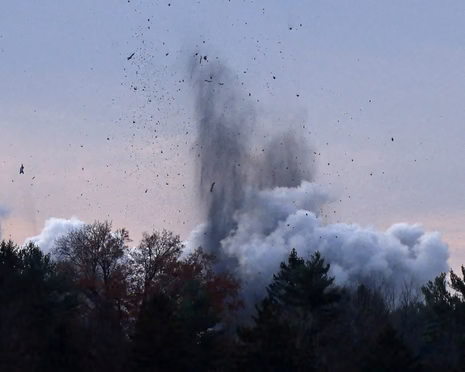
Images taken from a distance away appeared to show a white plume of smoke rising over the town immediately after the blast, before dissipating quickly. One local news station, KWQC, reported seeing a large amount of smoke from more than a mile away.
A local reporter in Iowa, who was live on air when the detonation happened, said he heard “a big boom” and and could “actually visibly see the shockwave coming through”.
Others were less impressed by the size of the blast. Tim Brandt, a resident of Burlington, Iowa, told the Associated Press that he wanted to see a big boom and feel the ground shake, but that instead, the detonation reminded him of the noisemakers that crack when thrown on the ground.
“It was nothing,” he said. “It seemed like government put fear in a lot of people over nothing.”
Shortly after the detonation, Donald Trump said in a post on Truth Social that “early reports from Iowa are that the Army’s mitigation efforts have far exceeded expectations”.
Lee Zeldin, head of the US Environmental Protection Agency (EPA), said that he has been told that the blast “caved inward perfectly”.
He said: “When the army was planning its mitigation efforts, there were a number of actions that were taken that included an effort to get the detonation to go… downland and toward unoccupied land within the Iowa army ammunition plant.”
“This message that I just received … First off, the air monitors are showing a remaining zero detection, and as far as the blast itself, it caved inward perfectly.”
The EPA added in a statement that “real-time air monitors are reporting ZERO detection of airborne lead throughout the region” and that monitors “never stopped collecting data throughout the event”. The agency also launched a website through which visitors can monitor live air quality readings along the plume route.
The acting army secretary, Adam Telle, said that that “the threat of an uncontrolled spontaneous detonation has been eliminated”.
“I am so proud of our SOLDIERS for their courage, training, mitigation and precision! They put it on the line for all of us just like this every day!” he said in a statement. Telle also thanked Trump and his administration “for mobilizing an unprecedented whole of government approach to fix this problem once and for all for the great people of Iowa”.
Lead azide, which typically appears as a white powder or needle-like crystals, is a explosive chemical compound of lead used mainly in detonators, according to the National Center for Biotechnology Information.
The US army said that a routine inspection in March at the Iowa facility found that “decades-old, stored lead azide had partially crystallized, making it increasingly sensitive to friction, shock and cold winter temperatures”.
 Share your thoughts in the Forum